Hexarelin
Also known as: Hexarelin Acetate
The most potent GHRP per microgram — and the one that desensitises fastest. A short-cycle tool, not a long-term protocol, with a cortisol lift that Ipamorelin avoids.
Overview
Hexarelin is a six-amino-acid GHRP, structurally close to GHRP-6 but with a methylated histidine that boosts potency. The GH pulse is bigger than Ipamorelin's at equimolar dose — by a meaningful margin — and the animal literature also shows cardioprotective effects through a separate receptor (CD36), which is interesting but not the reason most people use it. The cost of the bigger pulse is twofold: cortisol and prolactin rise more, and the GHS receptor downregulates faster under chronic stimulation. The right framing is that Hexarelin is the tool for a 4–6 week intensive — recovery from a hard training block, a body-recomp push before a deadline — not a peptide to run indefinitely.
Evidence quality
Multiple short clinical pharmacology studies from the 1990s — including the canonical Imbimbo and colleagues work — characterise the GH pulse, the cortisol/prolactin lift, and the desensitisation kinetics. The cardioprotective signal through CD36 is mostly animal data. No long-term outcome trials in healthy adults. Use it for the short-cycle pharmacology it was studied for; the chronic-use evidence base does not exist.
Benefits & timeline
Benefits
- Strong GH pulse — meaningfully larger than Ipamorelin at the same microgram dose
- Cardioprotective effects in animal models, mediated through CD36 (mechanistically distinct from the GH pathway)
- Useful for short, intensive cycles where pulse magnitude matters more than long-term sustainability
- Improved lean-mass retention during caloric deficit at the 4–6 week timescale
Timeline
Week 1
Noticeable sleep change and recovery improvement, often more pronounced than with Ipamorelin.
Week 2–3
Peak effect window. This is where Hexarelin earns its place over the cleaner GHRPs.
Week 4
Receptor desensitisation starts becoming detectable. The pulse softens.
Week 6
Hard ceiling. Cycle off — six weeks is the realistic maximum, four is safer.
Off-cycle
At least six weeks off, ideally longer. Hexarelin's GHS receptor recovery is slower than the other GHRPs because it desensitised harder.
Dosage protocols
Advanced
300 mcg
twice daily
Beginner
100 mcg
once daily
Standard
200 mcg
twice daily
Strong GH pulse but desensitisation can occur.
Titration & adjustment
Start at 100 mcg once daily for 2 weeks to gauge cortisol/prolactin tolerance. If labs and subjective tolerance are fine, increase to 200 mcg twice daily for the remaining 4 weeks of the cycle. Hexarelin desensitises faster than Ipamorelin — never cycle longer than 6 weeks, and always pause for at least 6 weeks before repeating.
Injection timing

Pre-workout for the strongest performance benefit, or pre-bed for sleep. Fasted state is more important for Hexarelin than for Ipamorelin because the GH pulse is sharper and food-suppressible.
Side effects & contraindications

- moderateCortisol and prolactin elevation at higher doses. Less than the old GHRPs but more than Ipamorelin — the trade-off for the bigger pulse.
- mildFlushing and head-rush, especially with fast injection.
- mildMild hunger 30–60 minutes after the shot.
- moderateFaster receptor desensitisation than other GHRPs. This is structural, not a quirk — the potency that makes Hexarelin attractive is what shortens the cycle window.
Contraindications
- Active cancer or recent cancer history
- Pregnancy or breastfeeding
- Elevated baseline cortisol or prolactin (Cushing's, prolactinoma, high stress periods with poor sleep)
- Chronic indefinite use — Hexarelin is structurally a short-cycle peptide; running it long-term works against its own mechanism
Reconstitution & injection
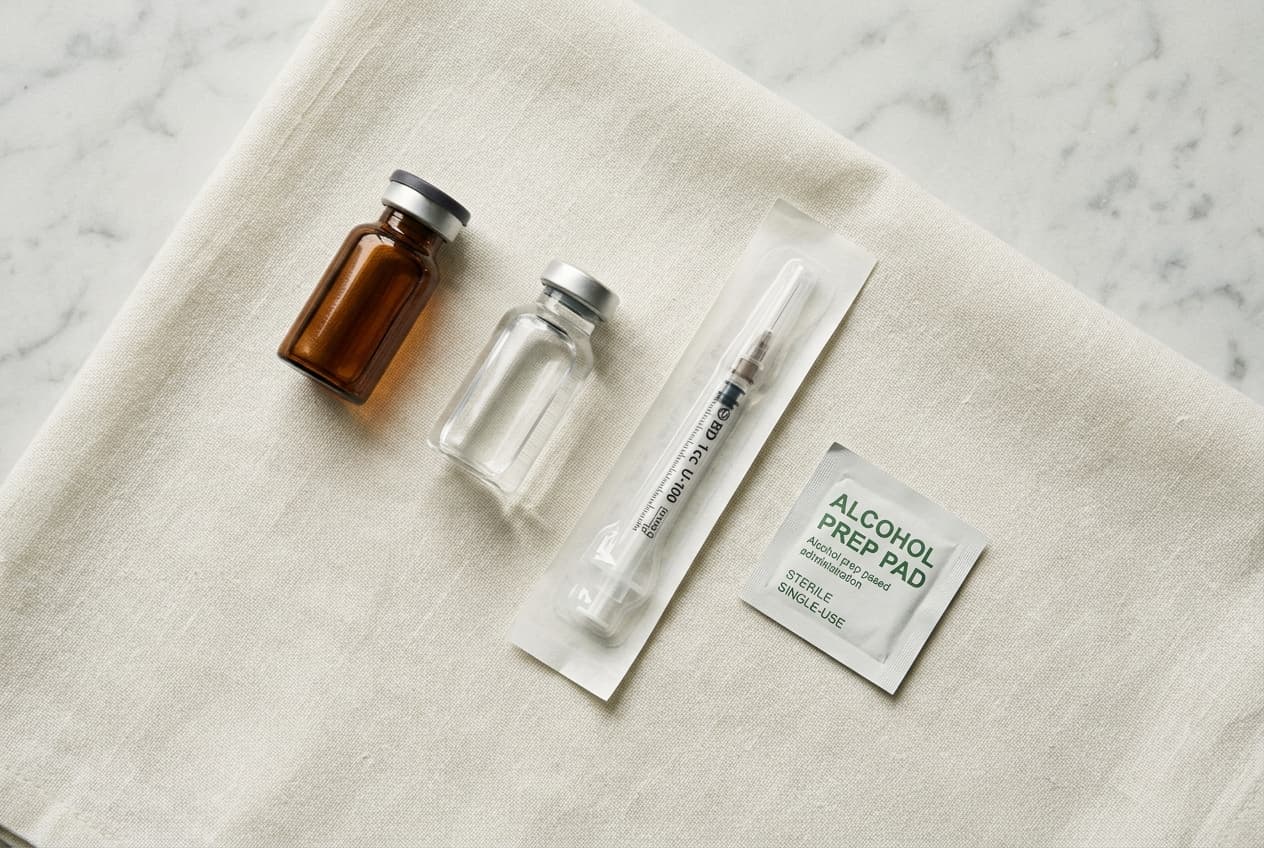
A 5 mg vial mixed with 2 ml bacteriostatic water gives 2.5 mg/ml. A 200 mcg dose is 0.08 ml — 8 units on a U-100 insulin syringe. A 100 mcg starting dose is 4 units. Subcutaneous abdomen, on an empty stomach. The fasted-state requirement is stricter for Hexarelin than for Ipamorelin — the pulse is sharper and food blunts it more.
Open calculator pre-filledStorage after reconstitution
Refrigerate at 2–8 °C after reconstitution. Do not freeze. Light-protect. 28 days of stability at fridge temperature. Because hexarelin cycles are kept short (≤6 weeks) to prevent desensitisation, you typically finish a vial well before any stability concern arises.
Common mistakes
Running Hexarelin like Ipamorelin — 12-week cycles, daily indefinitely.
Better approach: The receptor downregulates in 4–6 weeks. The protocol that works is short-and-intensive, not long-and-steady. Cycle 4–6 weeks on, 6 or more weeks off, and the second cycle still works. Run it like a cleaner GHRP and it stops working halfway through.
Stacking Hexarelin with another GHRP for 'more pulse'.
Better approach: Two GHRPs compete at the same receptor — you get one desensitised receptor twice as fast. Stack with a GHRH (CJC-1295 or Sermorelin) instead; that is the mechanism that actually amplifies the pulse.
Ignoring cortisol on long cycles.
Better approach: If you are running Hexarelin beyond 4 weeks, check morning cortisol. The lift is dose-dependent and the lab tells you whether you are inside the safety margin. Subjective signs (sleep quality dropping, anxiety creeping up) are late indicators.
Eating with the shot because it 'felt fine'.
Better approach: Insulin blunts Hexarelin's pulse more than Ipamorelin's. The 30-minute food-free window is not optional for this peptide; it is what makes the dose worth taking.
Real-world tips
- Treat Hexarelin like a sprint, not a marathon. 4–6 weeks, then off for at least six.
- Pre-workout dosing produces a noticeable performance effect that Ipamorelin does not match. Pre-bed dosing produces a deeper sleep effect than most users expect.
- Slow the plunger. Hexarelin's flushing is more intense when injected fast.
- If you are running this for cardio-protective reasons (animal data), the dose-response and timing are not the same as for GH-pulse use. The evidence base for that use is thin.
- Refrigerate after reconstitution. Stability is comparable to Ipamorelin — 3–4 weeks at fridge temperature.
When something else is the better tool
Ipamorelin
Use instead when: You want a clean GHRP you can run for months. Ipamorelin trades pulse magnitude for cortisol/prolactin cleanness and slower receptor desensitisation — the right choice for long cycles.
GHRP-2
Use instead when: You want a strong pulse with mild appetite stimulation and you can tolerate moderate cortisol/prolactin lift. GHRP-2 sits between Ipamorelin and Hexarelin on the potency-vs-cleanness axis.
CJC-1295 + Ipamorelin stack
Use instead when: Long-term body recomposition is the goal. The GHRH + clean-GHRP combination produces a bigger total GH exposure across a 12-week cycle than Hexarelin can sustain, because Ipamorelin does not desensitise as fast.
- Hexarelin or Ipamorelin?
- Hexarelin for short intensive cycles where pulse magnitude matters; Ipamorelin for long, low-side-effect cycles. They are tools for different jobs, not interchangeable potencies of the same drug.
- How long can I run it?
- 4–6 weeks. After that the receptor is dialled down and you are paying for diminishing pulses. Off for at least 6 weeks before the next cycle.
- Will it raise my cortisol?
- Mildly, in a dose-dependent way. At 100 mcg the lift is small; at 300 mcg twice daily it is meaningful. If you are running long or high, check morning cortisol.
- Why does it desensitise faster than Ipamorelin?
- Bigger pulses produce more receptor internalisation. The same mechanism that makes Hexarelin potent makes the receptor downregulate harder. There is no protocol trick that escapes this — it is the structural cost of the potency.
- Is the cardio-protective effect real?
- In animals, through CD36, yes — the basic-science case is plausible. In humans, the data is thin and the dosing protocols that produced the animal effect are not necessarily the same as the GH-pulse dosing self-administering users run. Treat it as a possible bonus, not a primary indication.