
Kisspeptin-10
Also known as: Kp-10 · Metastin
The upstream trigger of the entire reproductive axis. Early human trials hint at uses for HSDD and hypothalamic amenorrhea; nothing is approved.
Overview
Kisspeptin sits one rung above GnRH on the reproductive ladder. When kisspeptin-expressing neurons in the hypothalamus fire, they tell the GnRH neurons to release GnRH, which tells the pituitary to release LH and FSH, which tells the gonads to make sex steroids. Kisspeptin-10 is the truncated active fragment used in research. The clinical signal so far is genuinely interesting — Imperial College London's group under Waljit Dhillo has run small Phase 1 and 2 studies showing kisspeptin can restart pulsatile GnRH release in women with hypothalamic amenorrhea and can boost sexual responsiveness in men and women with low desire — but the human evidence base is small, short, and not yet anywhere close to a labelled indication.
Evidence quality
The Dhillo group at Imperial College London has run the most clinically interesting human work — restored ovulatory cycles in hypothalamic amenorrhea, plus a small HSDD trial in women showing increased limbic activation on functional MRI. Sample sizes are in the dozens, not the thousands. There is no approved indication anywhere.
Benefits & timeline
Benefits
- Restores pulsatile GnRH signalling in functional hypothalamic amenorrhea (the most replicated finding)
- Modest libido and sexual-response increase in early HSDD trials in both sexes
- Acts above GnRH — useful when the downstream axis is intact but the upstream signal has gone quiet
- No suppression of endogenous production at typical research doses — it's a stimulator, not a replacement
Timeline
Single dose
Acute LH and FSH rise within 30–60 minutes; subjective libido change is variable.
Week 2–3
Hormonal labs (LH, FSH, oestradiol or testosterone) shift in responders. Non-responders look largely unchanged.
Week 4–6
Most users have a clear sense by here of whether they're in the responder bucket.
Off-cycle
Built-in 4 weeks off after every 6–8 week run; the hypothalamus needs the pause to keep its pulsatility honest.
Dosage protocols
Advanced
500 mcg
once daily
Beginner
100 mcg
once daily
Standard
250 mcg
once daily
Titration & adjustment
Start at 100 mcg subcutaneously once daily. After 2 weeks escalate to 250 mcg daily if libido/hormone improvements are not yet measurable. Maximum 500 mcg daily. Cycle off for 4 weeks every 8 weeks.
Injection timing

Once daily, time of day flexible. Pre-bed dosing may align with the natural overnight LH surge.
Side effects & contraindications

- mildInjection-site soreness.
- mildMild headache.
- mildTransient hot-flush sensation in the first hour after dosing — the upstream LH surge has its own vasomotor footprint.
- moderateLimited human safety data beyond a few months of dosing. The mechanism is physiological, but 'used inside the body for billions of years' isn't the same as 'characterised at the doses people are injecting'.
Contraindications
- Pregnancy
- Active hormone-sensitive cancer (breast, prostate) — restoring LH/FSH pulses is exactly what you don't want in this context
- Children and adolescents — the HPG axis is not a place for unsupervised experimentation
- Concurrent GnRH-agonist therapy for endometriosis or prostate cancer — the two work against each other
Reconstitution & injection
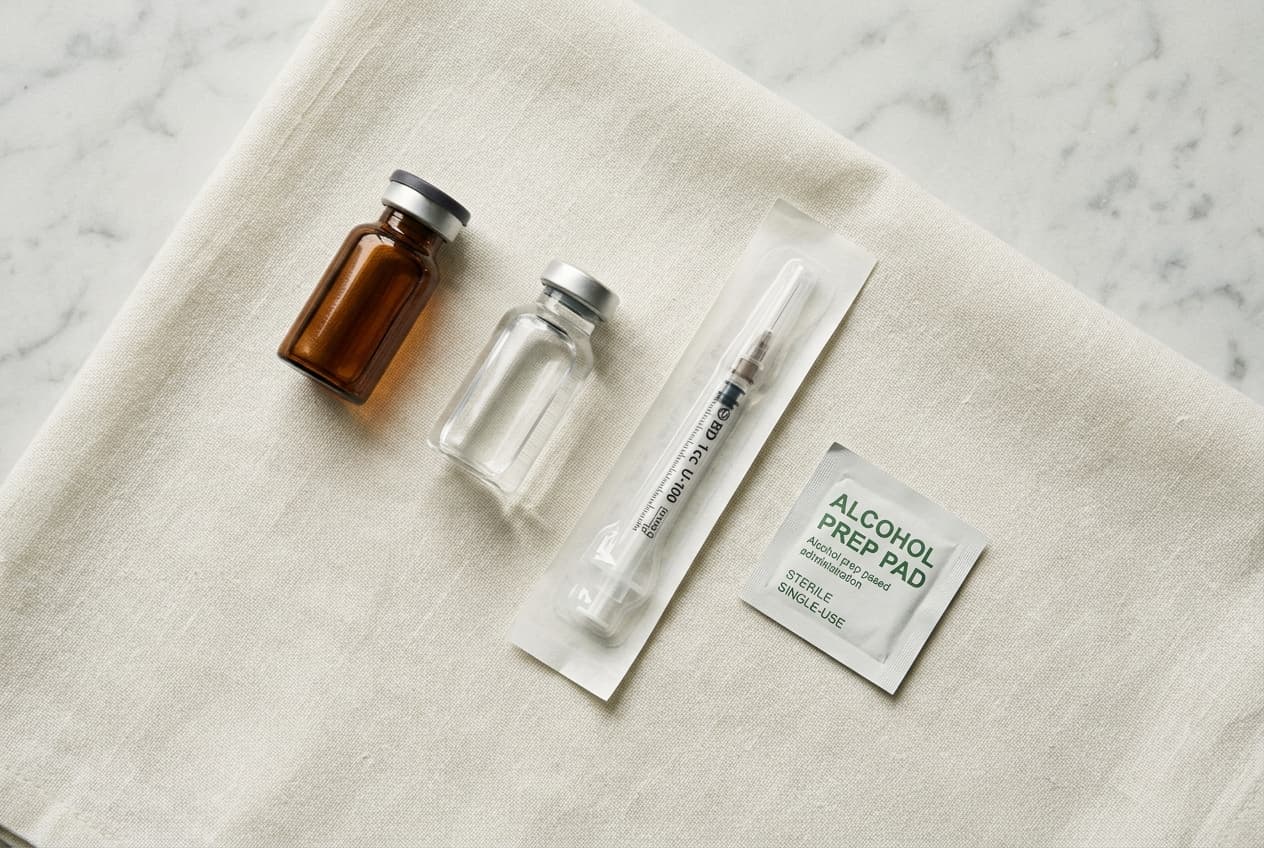
A 5 mg vial reconstituted with 2 ml bacteriostatic water gives 2.5 mg/ml. A 250 mcg dose is 0.1 ml, which is 10 units on a U-100 insulin syringe. Subcutaneous in the abdomen or thigh, once daily. Pre-bed dosing aligns with the natural overnight LH surge, but the half-life is short and time-of-day is not the variable that determines response.
Open calculator pre-filledStorage after reconstitution
Refrigerate at 2–8 °C after reconstitution. Do not freeze. Light-protected. 28–30 days of stability at fridge temperature in BAC water.
Common mistakes
Treating it like HCG.
Better approach: HCG mimics LH at the gonad. Kisspeptin acts on the hypothalamus. They sit on opposite ends of the axis, and substituting one for the other gets the physiology wrong. Pick the level of the axis you're actually trying to restore.
Expecting a libido drug.
Better approach: The libido signal in the trials is modest. If acute desire is your only target, PT-141 is more reliable. Kisspeptin is the better pick when the goal is restoring the underlying hormonal architecture, not bypassing it.
Running it continuously without off-cycles.
Better approach: Continuous high exposure to kisspeptin desensitises kisspeptin receptors and paradoxically suppresses GnRH release — the same trick that GnRH analogues exploit in prostate-cancer therapy. Cycle 6–8 weeks on, 4 weeks off.
Skipping bloodwork.
Better approach: This is one of the peptides where you can actually measure whether it's working. LH, FSH, oestradiol or testosterone before starting and at week 4 tell you in numbers whether you're a responder. Don't fly blind on a hormone axis.
Real-world tips
- Reconstituted vials are stable in the fridge for about 2 weeks. Past that, expect some potency loss.
- Pair it with a labs panel. The whole point of using this peptide is to confirm the axis is moving, not to take it on faith.
- If you're a woman tracking cycle restoration, chart basal body temperature alongside the labs — the biphasic shift is the cleanest signal that ovulation has returned.
- Don't combine with TRT in men trying to preserve fertility — the exogenous testosterone shuts the axis down upstream of where kisspeptin is trying to push it. The signals cancel.
- Build in the 4-week off period before you start. People who forget often find their response curve has flattened by week 10.
When something else is the better tool
HCG / gonadorelin
Use instead when: You want to keep testicular function during TRT or trigger ovulation. They act at the gonad and pituitary respectively — both downstream of kisspeptin and with much more clinical track record.
PT-141
Use instead when: Acute libido is the only goal and the underlying hormone panel is fine. Kisspeptin is the wrong tool when desire is the only complaint.
Pulsatile GnRH (clinical only)
Use instead when: Hypothalamic amenorrhea is the diagnosis and you have access to a specialist centre. The track record is longer and the protocols are better defined.
- Does it suppress my own production?
- At physiological pulsatile doses, no — it stimulates. At continuous high exposure, paradoxically yes. The pulse cadence matters as much as the dose.
- Can men use it for testosterone?
- Early data is promising but not enough to recommend it as a TRT alternative. If your goal is raising T and you have hypogonadism, treat the diagnosis with conventional therapy. Save kisspeptin for cases where preserving the natural pulsatility matters.
- What labs should I track?
- LH, FSH, oestradiol (women) or testosterone (men), and SHBG. Baseline and week 4. If nothing has moved by week 4, more weeks rarely change the picture.
- How does it compare to gonadorelin?
- Gonadorelin is GnRH itself — one rung lower. Kisspeptin is one rung higher. The choice depends on which part of the axis you suspect is dysregulated.
- Is there long-term safety data?
- No. Trials so far have run weeks to a few months. The mechanism is endogenous, which is reassuring, but 'endogenous' and 'safe at exogenous doses' are not the same thing.