Mazdutide
Also known as: IBI362 · LY3305677
Chinese-developed GLP-1 / glucagon co-agonist (IBI362, licensed from Eli Lilly's LY3305677). Solid Phase 2 data, approved in China for diabetes in 2024, investigational elsewhere.
Overview
Mazdutide is a dual agonist combining GLP-1's appetite suppression with glucagon's energy-expenditure boost — the same conceptual pairing as Survodutide. Innovent Biologics ran the Phase 2 programme in Chinese populations, which is relevant because Asian body-fat distribution and BMI cutoffs differ from the Western trial benchmarks the rest of this catalogue cites. The data shows 11–15% weight loss at 6 mg over 24 weeks and a useful side benefit on liver fat (ALT, hepatic fat fraction by MRI). China's NMPA approved it for type 2 diabetes in 2024; the obesity indication and Western regulatory pathway are still pending.
Evidence quality
Approved in China by NMPA in 2024 for type 2 diabetes based on the DREAMS-1 and DREAMS-2 trials. The published Phase 2 obesity data (Lancet Regional Health, 2023) showed 11–15% weight loss at 6 mg over 24 weeks in Chinese adults with obesity. Phase 3 trials in the obesity indication are still in progress. The Western evidence base is much thinner than for Tirzepatide because the trials have been Asia-led.
Benefits & timeline
Benefits
- 10–15% body-weight reduction at 6 mg over 24 weeks in Phase 2 Chinese trials
- Notable improvement in hepatic fat fraction — well-suited to users with NAFLD or elevated ALT
- Modest increase in resting energy expenditure from the glucagon arm
- Tolerability comparable to other dual agonists; some users handle it better than Tirzepatide
Timeline
Week 1–4
1.5 mg starter. Appetite reduction begins, GI side effects most pronounced.
Week 8–12
On 3–4.5 mg. Visible weight loss; ALT typically already trending down.
Week 16–24
Sitting at 6 mg. Phase 2 endpoint zone for the obesity arm.
Week 36–48
9 mg in the investigational top-dose tier. Limited published data beyond this point.
Dosage protocols

Advanced
9 mg
once weekly
Investigational; not yet approved outside China.
Beginner
3 mg
once weekly
Standard
6 mg
once weekly
Titration & adjustment
Start at 1.5 mg weekly for 4 weeks, then 3 mg for 4 weeks, then 4.5 mg for 4 weeks. The glucagon arm modestly raises resting heart rate; pause escalation if you feel persistently jittery. Most users plateau at 6 mg. Taper down in 1.5 mg steps every 2 weeks when finishing.
Injection timing

Once weekly, morning. Same miss-dose handling as other GLP-1 incretins. Avoid combining with high-stimulant pre-workouts in the first 48 hours after the shot.
Side effects & contraindications

- moderateNausea during dose escalation, typical incretin pattern.
- moderateMild resting heart rate increase (3–7 bpm) from the glucagon arm.
- mildConstipation and reduced appetite to a sometimes uncomfortable degree.
- severeInvestigational outside China — the Western long-term safety database is small.
Contraindications
- Personal or family history of medullary thyroid carcinoma
- Active pancreatitis
- Severe cardiovascular disease or uncontrolled tachyarrhythmia
- Pregnancy or active conception attempts
- Type 1 diabetes outside research protocols
Reconstitution & injection
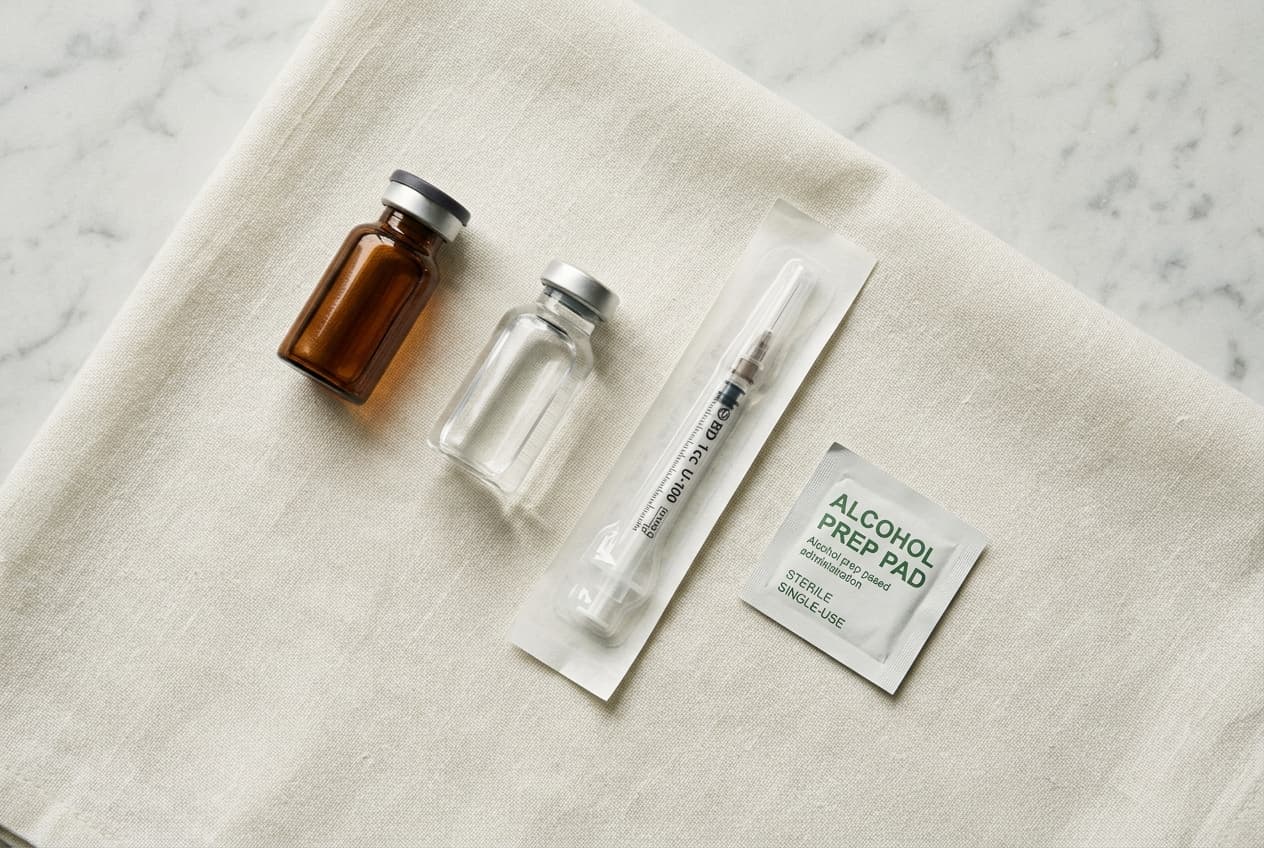
Research-grade comes as 10 mg lyophilised vials. Add 2 ml bacteriostatic water for 5 mg/ml — a 3 mg dose draws 0.6 ml, or 60 units on a U-100 insulin syringe; 6 mg is 1.2 ml; 9 mg requires 1.8 ml. Subcutaneous, once weekly, abdomen or thigh, rotating sites. Refrigerate after mixing; 4-week stability is typical.
Open calculator pre-filledStorage after reconstitution

Refrigerate at 2–8 °C after mixing. Do not freeze, do not expose to direct light or heat. Stable for 28 days post-reconstitution in BAC water. Because the glucagon arm raises resting heart rate, do not compensate by skipping a dose if storage was borderline — just discard a suspect vial and remix fresh.
Common mistakes
Assuming Western dose tolerability applies because the molecule looks like Tirzepatide.
Better approach: The published trials are in Chinese populations with lower average baseline BMI and different background diet. A 6 mg dose in a 100 kg Western user is not the same exposure profile as in a 75 kg trial participant. Start at the published starter dose (1.5 mg) and titrate carefully even if you have prior incretin experience.
Choosing Mazdutide because it sounds 'newer' than Tirzepatide.
Better approach: Tirzepatide has a much larger dataset, an approved indication in the Western markets, and clearer supply chains. Mazdutide is reasonable when you specifically want the glucagon arm (for liver fat or energy expenditure) without the cost or supply issues of Retatrutide. 'Newer' is not the same as 'better'.
Not tracking liver enzymes if you are using it for NAFLD.
Better approach: The liver-fat benefit is the strongest mechanistic argument for choosing Mazdutide over Semaglutide. Baseline an ALT/AST/GGT panel before starting and recheck at 12 and 24 weeks. Without the labs you cannot tell if the differentiating benefit is actually happening for you.
Stacking with other dual agonists or other glucagon-arm drugs.
Better approach: Two glucagon-arm drugs at once is a heart-rate experiment you do not want to run. Mazdutide alone or Mazdutide plus a non-overlapping mechanism (Cagrilintide, AOD9604) is the better stacking direction.
Real-world tips
- Get a baseline ALT/AST/GGT before starting. The liver benefit is the differentiator and you want to be able to demonstrate it.
- Track resting heart rate weekly. The glucagon arm adds the same HR signal as Retatrutide, milder in magnitude.
- Inject morning of a non-training day so the GI peak and any HR rise do not overlap with hard exercise.
- Source carefully. Most Western-available Mazdutide is research-grade out of Asian wholesalers; request a current HPLC assay and check for endotoxin testing.
- If you are switching from Tirzepatide, expect a slightly different appetite signal — less hedonic-food blunting, more pure satiety. Some users prefer it; some miss the Tirzepatide curve.
When something else is the better tool
Tirzepatide
Use instead when: You want the approved drug, the largest dataset, and the cleaner supply chain. Mazdutide's edge is the liver-fat signal; if NAFLD is not your driver, Tirzepatide is the easier choice.
Survodutide
Use instead when: You want a GLP-1/glucagon dual with Western trial data. Boehringer's Survodutide is the closer pharmacological neighbour; pick by data availability and your supplier's catalogue rather than expected efficacy.
Semaglutide plus addressing NAFLD with diet
Use instead when: Liver fat is your primary concern and you have not yet exhausted the cheaper, more proven combination of GLP-1 monotherapy plus a Mediterranean-style diet. The hepatic benefit of weight loss alone is substantial.
- Is it approved anywhere?
- Yes — China approved it for type 2 diabetes in 2024. The obesity indication is pending and Western regulatory submissions have not happened yet.
- How does it compare to Tirzepatide?
- Less head-to-head data exists because the trials were in different populations. Indirectly, the weight-loss numbers are slightly behind Tirzepatide but the liver-fat signal is stronger. Choose by what you are optimising for.
- Why is the development so Asia-led?
- Innovent Biologics licensed the molecule from Eli Lilly and ran the development programme primarily in China. Lilly retained rights to develop in other markets but has prioritised Tirzepatide and Retatrutide in their Western pipeline.
- Will it eventually be approved in the US or EU?
- Possible but not announced. The clinical profile is competitive but Lilly's existing portfolio (Tirzepatide approved, Retatrutide in Phase 3) creates cannibalisation friction. A Mazdutide approval in the West would likely be by a different sponsor or via a different indication.
- Is research-grade material safe to use?
- It is the same molecule when purity is real, but you cannot verify GMP manufacturing the way you can with an approved pen. Treat it as the same purity-and-sterility lottery as any unapproved peptide and ask for assays before injecting anything.