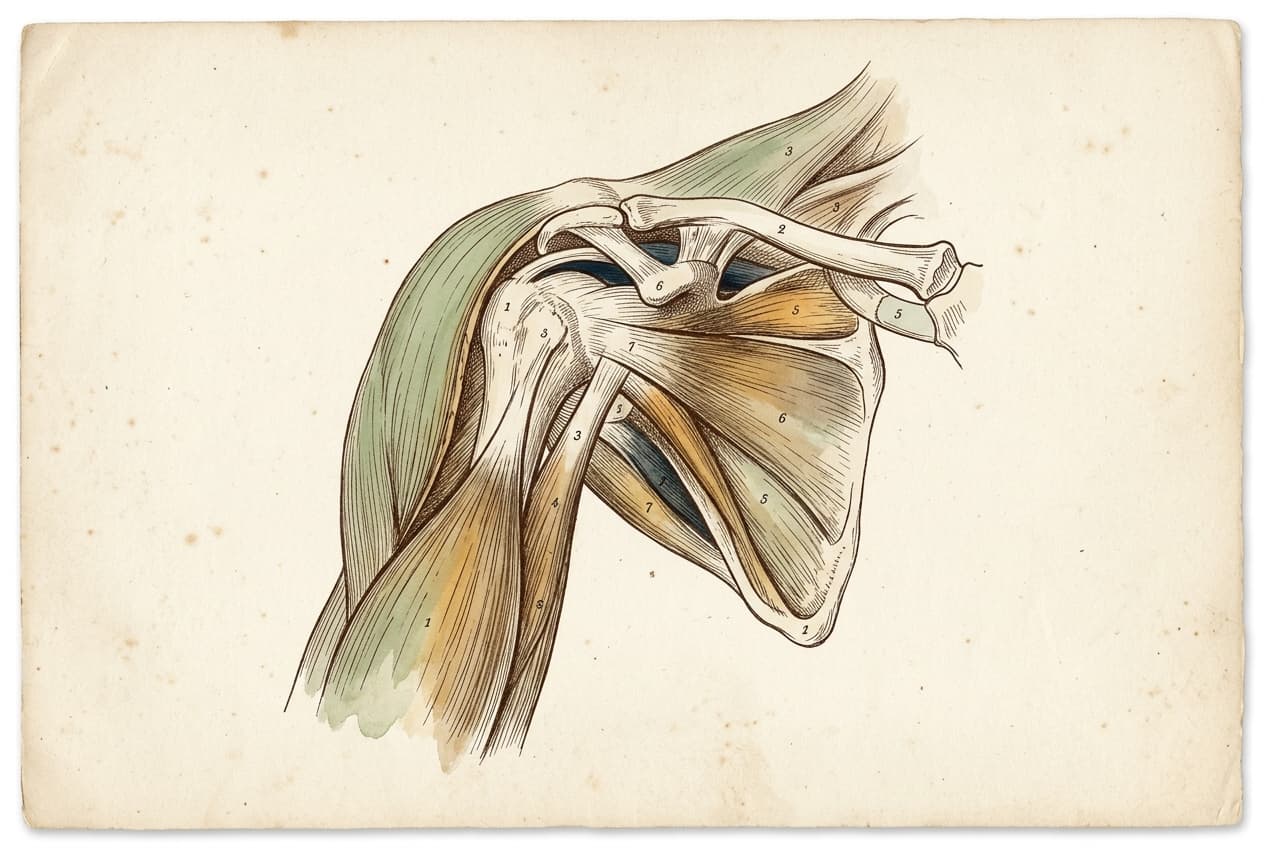
MGF (Mechano Growth Factor)
Also known as: Mechano Growth Factor · IGF-1Ec
A splice variant of IGF-1 that the body produces locally inside exercising muscle. Used as a post-workout intramuscular shot to amplify the local growth signal in trained tissue only.
Overview
MGF (also called IGF-1Ec) is what your muscle makes when you load it — a splice variant of the IGF-1 gene transcribed in response to mechanical stress. The role it plays endogenously is to activate satellite cells, the resident stem cells that fuse with damaged fibres to drive hypertrophy. As an injectable, MGF is dosed intramuscularly into the muscle you just trained, within 15 minutes of the last set, with the explicit goal of amplifying that local signal. The half-life is brutally short — minutes — which is exactly why the protocol is post-workout and intramuscular and not, say, daily subcut. Inject it systemically and you waste most of the dose. The honest evidence for MGF is preclinical with some open-label human data; the mechanism story is solid, but the clinical trials that would establish dose-response are not in the public literature.
Evidence quality
The endogenous role of the IGF-1Ec splice variant in satellite-cell activation is well established in muscle biology — animal models from the early 2000s mapped the mechanism in detail. Injectable MGF for hypertrophy in healthy adults is supported by small case series and community use, not by completed RCTs. The half-life problem (minutes in circulation) makes traditional clinical trial design awkward, which is part of why the human literature is so thin.
Benefits & timeline
Benefits
- Strong local hypertrophy signal in the injected muscle — satellite cell activation at the source
- No systemic IGF-1 elevation, so no hypoglycaemia risk and no whole-body mitogenic exposure
- Useful for rehab work on weakened or lagging muscle groups
- Pairs with the rest of the GH/IGF axis without compounding the systemic IGF-1 load
Timeline
Week 1
Recovery in the injected muscle improves first — less soreness, faster turnaround between sessions.
Week 2
Trained muscle starts to feel fuller and more responsive. Vascularity in the targeted area improves.
Week 4
Measurable hypertrophy in the injected muscles, asymmetric if you have only been targeting one group.
Week 6
Cycle off. Beyond this the local signalling adapts and the marginal benefit drops.
Off-cycle
4 weeks clear. Gains hold if training continues; the satellite-cell pool resets.
Dosage protocols

Advanced
400 mcg
post-workout, into trained muscle
Beginner
100 mcg
post-workout, into trained muscle (IM)
Standard
200 mcg
post-workout, into trained muscle
Titration & adjustment
No titration in the systemic sense — MGF is dosed locally into the trained muscle immediately post-workout. Start at 100 mcg per injection. After 2 weeks, escalate to 200 mcg if injection-site soreness is tolerable. Maximum 400 mcg per site. Rotate muscle groups across the week.
Injection timing

Strictly post-workout — within 15 minutes of finishing the trained muscle group. Inject directly into the worked muscle (intramuscular). Do not dose on rest days.
Side effects & contraindications

- mildInjection-site soreness lasting 24–48 hours — the IM route is the dominant factor here, not the peptide itself.
- mildMild local swelling in the trained muscle.
- mildSmall visible asymmetry if a single muscle is dosed repeatedly without rotating across the body.
- moderateNo long-term human safety data outside of small case series.
Contraindications
- Active cancer or recent cancer history — IGF-1 family signalling is the mechanism to avoid
- Pregnancy or breastfeeding
- Untrained users — without the mechanical-load context, MGF has nothing to amplify
- Anyone unwilling to inject intramuscularly into the trained muscle (the protocol is route-specific and route changes break the protocol)
Reconstitution & injection
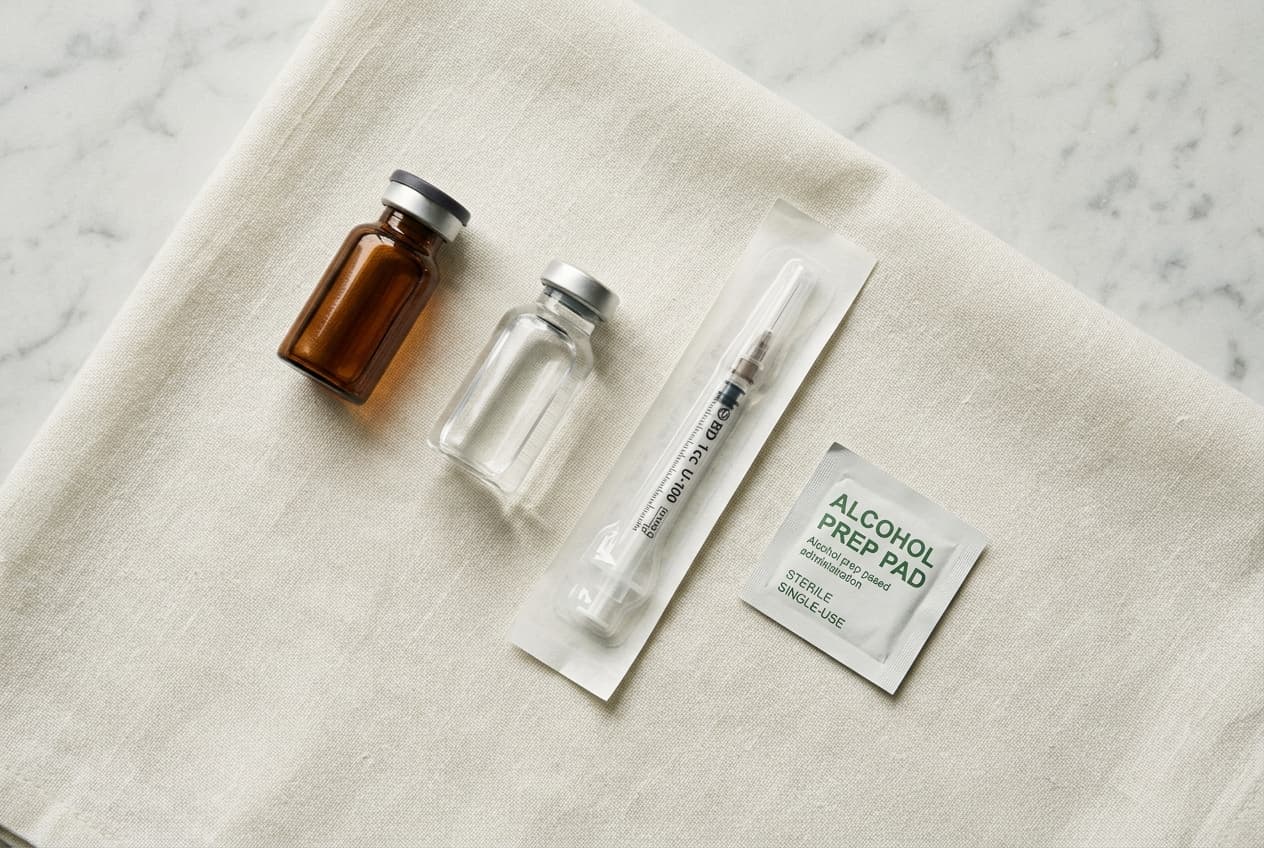
A 2 mg vial reconstituted with 2 ml of bacteriostatic water gives 1 mg/ml. A 200 mcg dose is 0.2 ml — 20 units on a U-100 insulin syringe. Intramuscular into the trained muscle, within 15 minutes of finishing the last working set for that muscle group. Use a longer needle than you would for subcut (5/8 to 1 inch depending on body composition) so the peptide actually lands in muscle and not subcutaneous fat. Refrigerate after mixing; reconstituted stability is short — most users mix small vials and use within 2 weeks.
Open calculator pre-filledStorage after reconstitution

Refrigerate at 2–8 °C after reconstitution. Do not freeze. Light-protected. MGF (mechano-growth factor, the non-pegylated form) is notably unstable — fridge stability is 10–14 days only. Mix small batches that match your training schedule rather than reconstituting a full vial. The pegylated version (PEG-MGF) is much more stable.
Common mistakes
Injecting MGF subcutaneously to avoid the IM discomfort.
Better approach: The protocol depends on getting peptide into the trained muscle within minutes of the workout. Subcutaneous dosing wastes most of the molecule before it reaches the target tissue. If IM is the dealbreaker, switch to PEG-MGF — which is designed for systemic subcut dosing — rather than running MGF the wrong way.
Dosing on rest days.
Better approach: Without the acute mechanical-stress signal in the muscle, there is nothing for the MGF dose to amplify. The protocol is post-workout-only by mechanism, not by convention. Save the vials for training days; skip the rest days entirely.
Hitting the same muscle every session for 4 weeks straight.
Better approach: Local growth at the injection site is the goal, but unilateral dosing produces visible asymmetry quickly. Rotate across muscle groups (chest one day, back the next, legs the day after) and split each dose between left and right sides of the muscle if you want the local effect without the lopsided look.
Treating MGF as a daily anabolic.
Better approach: MGF is a post-workout amplifier, not a daily growth signal. For daily systemic anabolism, IGF-1 LR3 is the molecule to look at — with the corresponding hypoglycaemia and systemic risks. For systemic MGF action specifically, PEG-MGF is the pegylated version designed for twice-weekly subcutaneous use.
Real-world tips
- Pre-mix and warm to room temperature before the workout — cold injections sting more than warm ones.
- Use a 25–27g IM needle of appropriate length for the muscle being targeted. A 5/8 inch needle into a glute will land in subcut.
- Inject within 15 minutes of finishing the last set. The window matters because the endogenous MGF signal is already firing — you are adding to it, not replacing it.
- Track muscle measurements (arm cold, calf cold, thigh cold) every two weeks. The asymmetry — and the symmetry — is the most honest metric for whether the local effect is real for you.
- Skip the dose if you skipped the workout. The protocol is not transferable across days.
When something else is the better tool
PEG-MGF
Use instead when: You want the MGF mechanism without the post-workout-IM requirement. PEG-MGF trades the locality for convenience — twice-weekly systemic subcut dosing that still drives satellite-cell signalling, just without the precise targeting MGF allows.
IGF-1 LR3
Use instead when: The goal is full-body hypertrophy and you are willing to accept the hypoglycaemia and systemic risk for a stronger anabolic signal. LR3 is the heavier tool with the bigger profile; MGF is the precise local tool with the smaller footprint.
Targeted training (lengthened-partial work, blood flow restriction)
Use instead when: You have not yet exhausted the training stimulus for the lagging muscle group. Specialised training protocols drive endogenous MGF release in the targeted muscle for free. Run the training intervention first; add MGF if the muscle still resists growth.
- Why intramuscular and not subcut?
- MGF's half-life is minutes. To get the peptide into the trained muscle while the local growth signal is still firing, you inject it into that muscle. Subcut dosing means the molecule is mostly gone before it diffuses anywhere useful.
- Will I lose the gains when I stop?
- The hypertrophy holds as long as you keep training. The satellite-cell pool that drives growth resets during the off-cycle — you do not lose existing muscle by stopping MGF, you just stop adding new signal.
- Can I inject pre-workout instead?
- No. The mechanism requires the muscle to already be mechanically stressed. Pre-workout dosing wastes the peptide on resting tissue.
- Do I need to combine it with anything?
- Not strictly — MGF stands alone as a local hypertrophy tool. The most common pairing is with HGH or CJC-1295/Ipamorelin, where the systemic GH/IGF-1 axis provides the broad context and MGF amplifies the specific muscles you want to develop.
- Is the asymmetry permanent?
- It hangs on as long as the asymmetric stimulus does. Rotate sides and muscles to keep development balanced, or use the asymmetric dosing deliberately to bring up a lagging side.