
PEG-MGF
Also known as: PEG-MGF · PEGylated MGF
Pegylated MGF — the same satellite-cell-activating peptide as regular MGF, but with a polyethylene glycol chain that stretches the half-life from minutes to days. Trades the locality story for twice-weekly convenience.
Overview
PEG-MGF takes the MGF molecule and bolts a polyethylene glycol chain onto it, which is the same trick used on most modern long-acting peptide drugs. The pegylation protects the peptide from rapid clearance, extending the functional half-life into the range where twice-weekly subcutaneous dosing produces sustained satellite-cell signalling. The trade-off is that you lose the precise locality of unpegylated MGF — the molecule circulates systemically rather than acting only in the trained muscle where it was injected. For users who train multiple muscle groups across the week and would rather not do post-workout intramuscular injections every session, PEG-MGF is the practical compromise. For users who specifically want to target a lagging muscle group, regular MGF is still the better tool.
Evidence quality
The pegylation chemistry is well established from drug-development work on PEG-Filgrastim, PEG-Interferon, and other approved pegylated biologics. The specific PEG-MGF molecule has not been subjected to dedicated human RCTs for hypertrophy in healthy adults. The endogenous biology of the parent MGF molecule is preclinically well characterised; the leap from that to PEG-MGF as a hypertrophy tool is plausible but unproven in formal trials.
Benefits & timeline
Benefits
- Twice-weekly dosing instead of every-training-session — much easier to fit into a real schedule
- Sustained satellite-cell signal across the entire week, not just the post-workout window
- Subcutaneous route — no intramuscular injection required
- Useful for users with infrequent training (2–3 sessions/week) where the post-workout-MGF protocol leaves gaps
Timeline
Week 1
Recovery improves systemically. Mild flu-like feeling in the first day or two for some users.
Week 2
Pumps fuller in the gym across all trained muscle groups.
Week 4
Hypertrophy becomes measurable, more evenly distributed than with the local MGF protocol.
Week 6
Cycle off. Beyond this the receptor signalling adapts and the marginal benefit drops.
Off-cycle
4 weeks clear. Gains hold if training continues.
Dosage protocols

Advanced
400 mcg
twice weekly
Beginner
100 mcg
twice weekly
Standard
200 mcg
twice weekly
Titration & adjustment
Start at 100 mcg twice weekly. After 2 weeks, escalate to 200 mcg twice weekly. Maximum 400 mcg twice weekly. Unlike unpegylated MGF, the dose is systemic and works regardless of training timing — but pairing with a training day still amplifies the local growth signal.
Injection timing

Twice weekly, ideally on the two most intense training days. Subcutaneous; muscle-site does not matter as it is systemic. Dose post-workout if possible to align with the natural growth-factor window.
Side effects & contraindications

- mildInjection-site irritation — pegylated peptides occasionally produce a slow-resolving small bump.
- mildMild flu-like symptoms in the first few days of a cycle, usually fading within a week.
- mildSlight water retention.
- moderateNo long-term human safety data, and the pegylation adds an additional unknown — the PEG chain itself has been linked in some long-term pharmaceutical studies to vacuolation in tissues. Probably not clinically relevant at peptide doses; certainly not zero.
Contraindications
- Active cancer or recent cancer history
- Pregnancy or breastfeeding
- Documented PEG allergy or PEG sensitivity — rare but real
- Untrained users — same logic as regular MGF, satellite-cell signalling needs a training stimulus to amplify
Reconstitution & injection
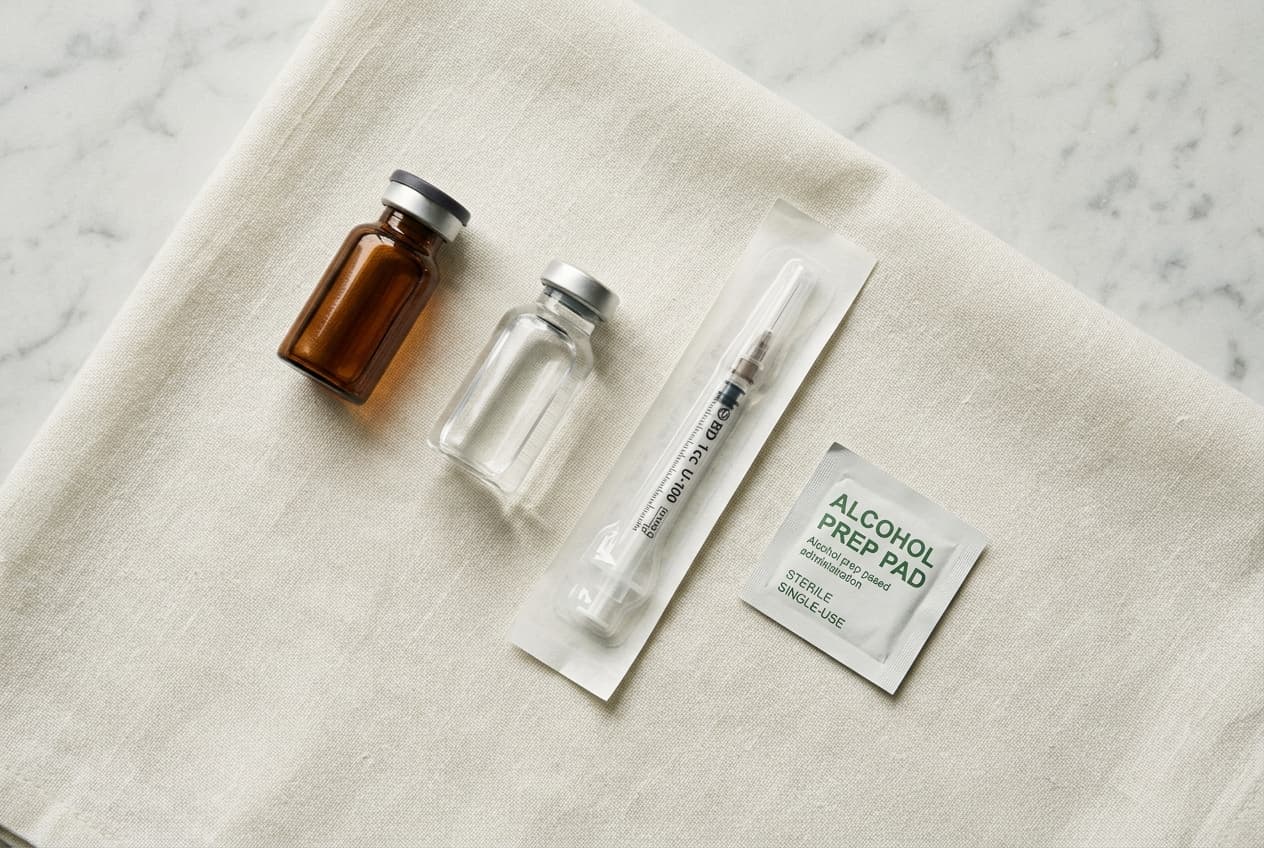
A 2 mg vial with 2 ml of bacteriostatic water gives 1 mg/ml. A 200 mcg dose is 0.2 ml — 20 units on a U-100 insulin syringe. Subcutaneous, into abdomen or thigh, twice weekly. Unlike unpegylated MGF, the site of injection does not matter — the peptide circulates systemically and reaches all trained muscles equally. If you can time one of the two weekly doses to a training day, the local growth-factor window adds a small bonus on top of the systemic signal, but it is not required. Refrigerate after mixing; pegylated peptides are generally more stable than their parent molecules, but the 4-week storage limit is the safe assumption.
Open calculator pre-filledStorage after reconstitution

Refrigerate at 2–8 °C after reconstitution. Do not freeze. Light-protected. The pegylation dramatically improves in-vial stability — PEG-MGF holds potency for 28–30 days at fridge temperature, in contrast to the bare MGF molecule. Solution should remain clear; any precipitate means discard.
Common mistakes
Treating PEG-MGF as a stronger version of MGF.
Better approach: It is not stronger — it is longer-acting. The peak signal in any one muscle is lower than what you get from a targeted post-workout MGF shot into that muscle. The trade is duration for amplitude. If you want a strong signal in one specific muscle, MGF wins. If you want a sustained signal across the body, PEG-MGF wins.
Dosing daily because 'more is better'.
Better approach: The pegylation is specifically designed for twice-weekly dosing — the molecule is still active when the next dose lands. Daily dosing produces accumulating exposure without proportional benefit and wastes vials. Twice weekly is the protocol; stick with it.
Combining with regular MGF on the same training day.
Better approach: The combination is not dangerous, but it is redundant — both molecules drive the same receptor signalling. Pick one. PEG-MGF for general convenience; unpegylated MGF for targeted lagging-muscle work. Running both is paying twice for one effect.
Real-world tips
- Pick two fixed days per week — Monday/Thursday is a common rotation. Pegylated half-lives reward consistency over timing precision.
- Try to overlap one of the two doses with a hard training day. The systemic signal is independent of training timing, but the local growth-factor window opens after a heavy session and gives the dose a small extra hook.
- Rotate injection sites across the abdomen — pegylated injection-site bumps are slower to resolve than non-pegylated.
- If the flu-like first-week feeling is intense, drop to a single weekly dose for week 1 and then move to the twice-weekly protocol from week 2.
- Keep an eye on body weight in the first two weeks — some of any early gain is water from the systemic IGF-1-family signalling.
When something else is the better tool
MGF
Use instead when: You want to target one specific lagging muscle group with the strongest possible local signal, and you are willing to do a post-workout intramuscular injection every training session for that muscle. The locality of unpegylated MGF is its defining feature.
IGF-1 LR3
Use instead when: You want the strongest possible systemic anabolic signal and you are willing to accept the hypoglycaemia risk and the 4-week cycle ceiling. LR3 is the heavier tool with the bigger acute effect; PEG-MGF is the gentler tool with a longer cycle window and no hypoglycaemia footprint.
HGH + good training
Use instead when: You are after general body recomposition with sleep, recovery, and broad GH-axis benefits rather than precise hypertrophy signalling. HGH is the broader tool with a longer regulatory track record; PEG-MGF is the narrower tool aimed at satellite-cell activation specifically.
- PEG-MGF or MGF?
- Convenience versus precision. PEG-MGF is twice-weekly subcut, systemic, easier to fit into a real life. MGF is post-workout IM, local, stronger in the specific muscle injected. Most users land on PEG-MGF for the practicality and use MGF only when they have a specific lagging muscle to target.
- Does the PEG chain itself do anything I should worry about?
- Pegylation is mature pharmaceutical chemistry — the same approach is used on several approved drugs. At peptide doses there is no clinical signal for harm. Long-term high-dose pegylated drugs have shown tissue vacuolation in some studies, but the relevance to peptide-dose use is low. Not zero, just low.
- Will it accumulate in my system over the cycle?
- Mild accumulation is expected from the half-life — that is the point of pegylation. By week 2 you reach a relatively steady level that holds across the cycle. The half-life is days, not weeks, so there is no runaway buildup.
- Can I combine it with HGH or a GHRH/GHRP stack?
- Yes — the mechanisms are complementary. The GH-axis tools drive systemic IGF-1; PEG-MGF drives the satellite-cell-specific signalling that translates IGF-1 elevation into muscle growth. The combination is common in advanced protocols.
- How fast will I see results?
- Recovery effects in the first week, measurable hypertrophy by week 4 if training and nutrition support it. If nothing has changed by week 6, the protocol or the training stimulus — not the molecule — is the variable to adjust.