
Survodutide
Also known as: Survodutide
Boehringer Ingelheim's investigational GLP-1 / glucagon dual agonist. Phase 2 weight loss in the 15–19% range, with a notable side-effect on liver fibrosis in NASH patients.
Overview
Survodutide (formerly BI 456906) is the dual agonist sitting between Mazdutide (the China-led GLP-1/glucagon) and Retatrutide (the triple). The GLP-1 arm handles appetite; the glucagon arm pushes energy expenditure and acts on hepatic fat. Boehringer's Phase 2 obesity trial reported 14.9–18.7% weight loss at 46 weeks across the dose range, and a separate Phase 2 NASH trial showed meaningful improvement in liver fibrosis — a harder endpoint than the fat-fraction signal most incretins produce. Phase 3 (the SYNCHRONIZE programme) is enrolling. No regulatory approval yet, and outside of trials this is research-grade only.
Evidence quality
Boehringer Ingelheim's Phase 2 obesity trial (NEJM 2024) showed 14.9–18.7% weight loss at 46 weeks. A separate Phase 2 NASH trial demonstrated liver-fibrosis improvement in roughly 60% of treated patients. Phase 3 (SYNCHRONIZE-1 through 4) is enrolling, covering obesity, cardiovascular outcomes, and NASH. No approval anywhere as of 2026. The dataset is solid for Phase 2 but smaller than Tirzepatide or Semaglutide by orders of magnitude.
Benefits & timeline
Benefits
- Phase 2 weight loss of ~15–19% at 46 weeks across the dose range
- Meaningful liver-fibrosis improvement in NASH Phase 2 (a stricter endpoint than hepatic fat fraction)
- Glucagon-mediated energy expenditure partially offsets dieting adaptation
- Once-weekly dosing — fits the existing incretin rhythm
Timeline
Week 1–4
0.3 mg starter. Appetite suppression begins, GI symptoms most pronounced.
Week 8–16
Climbing through 0.9, 1.8, 2.7 mg in 4-week steps. Weight loss building steadily.
Week 20–28
On 3.6 mg. Resting heart rate often up 5–8 bpm; monitor weekly.
Week 36–46
On 6 mg for users escalating fully. Phase 2 endpoint zone.
Dosage protocols

Advanced
6 mg
once weekly
Investigational dual GLP-1/glucagon co-agonist.
Beginner
0.3 mg
once weekly
Standard
3.6 mg
once weekly
Titration & adjustment
Phase 2 trial titration: 0.3 mg weekly for 4 weeks, then 0.9 → 1.8 → 2.7 → 3.6 mg in 4-week steps. Maximum studied 6 mg. Monitor resting heart rate weekly because of the glucagon arm. Taper down by one step every 2 weeks when finishing.
Injection timing

Once weekly, fixed weekday. Avoid stimulant-heavy training days within 24 hours of injection because of the glucagon arm.
Side effects & contraindications

- moderateNausea and vomiting during titration — similar pattern to Mazdutide and Retatrutide.
- moderateResting heart rate rises 5–8 bpm at higher doses.
- mildMild jitteriness or anxiety in sensitive users from the glucagon arm.
- severeInvestigational — long-term safety database is small and Phase 3 has not concluded.
Contraindications
- Resting heart rate above 100 bpm or uncontrolled arrhythmia
- Personal or family history of medullary thyroid carcinoma
- Active or recent pancreatitis
- Severe hepatic impairment outside NASH trial protocols
- Pregnancy or active conception attempts
Reconstitution & injection
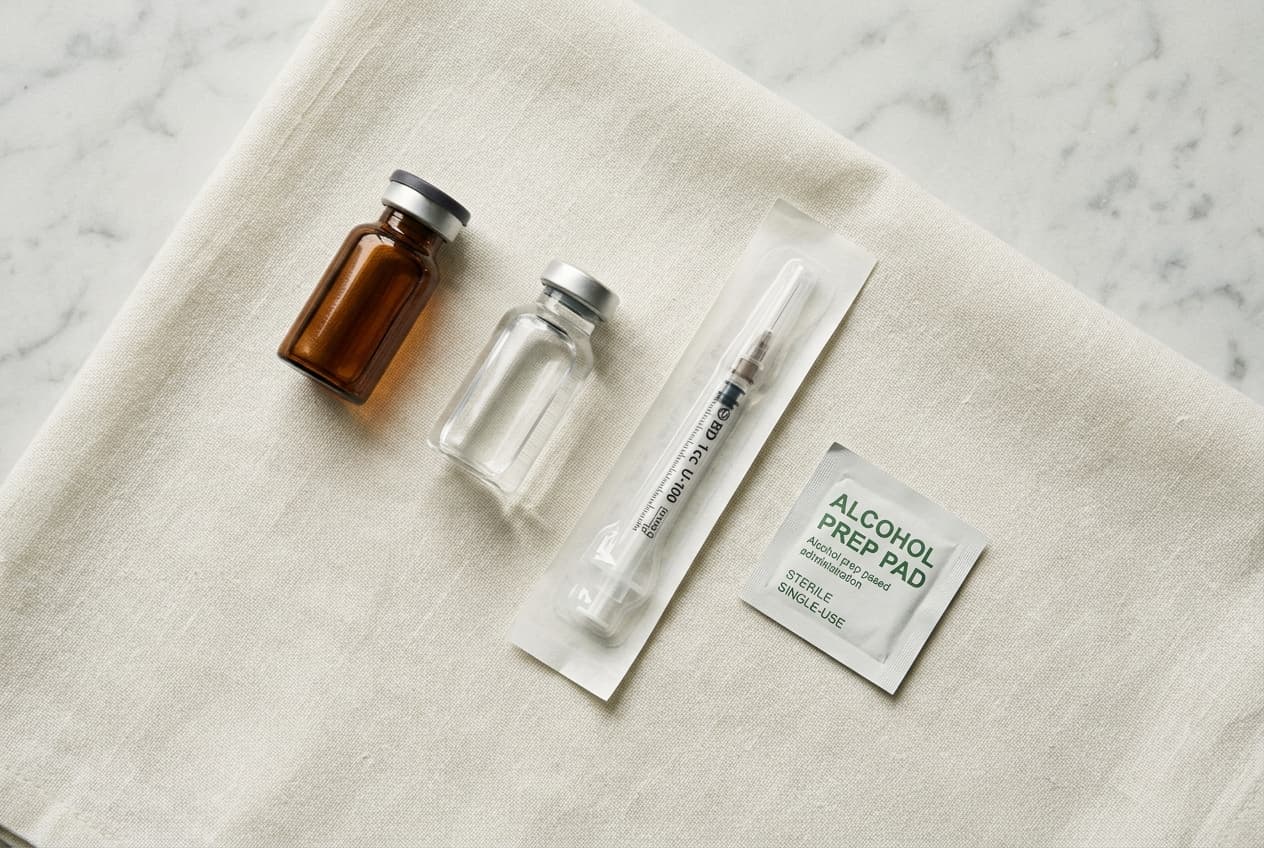
Research-grade comes as 10 mg lyophilised vials. Reconstitute with 2 ml bacteriostatic water for 5 mg/ml — a 0.3 mg starter dose draws 0.06 ml, or 6 units on a U-100 insulin syringe; 3.6 mg is 0.72 ml (72 units); 6 mg is 1.2 ml. Subcutaneous, once weekly, abdomen or thigh, rotating sites. Fridge stability is 4 weeks once mixed.
Open calculator pre-filledStorage after reconstitution
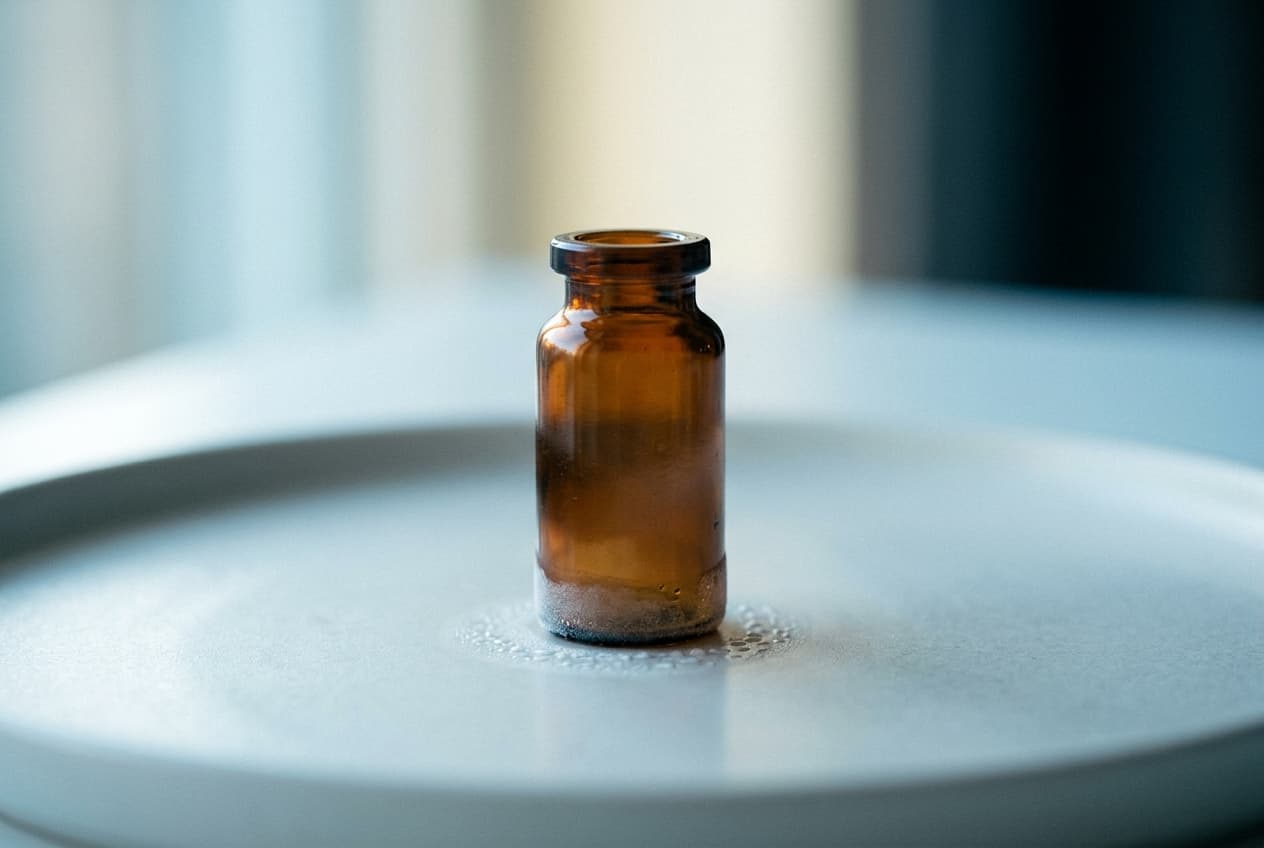
Refrigerate at 2–8 °C immediately after mixing. Do not freeze. Light-protected. 28 days of stability in BAC water at fridge temperature. The glucagon component is the most thermolabile part of the molecule — a vial left at room temperature overnight is suspect; discard and remix.
Common mistakes
Confusing Survodutide with Retatrutide because both have a glucagon arm.
Better approach: Survodutide is dual (GLP-1 + glucagon); Retatrutide is triple (GIP + GLP-1 + glucagon). The Phase 2 weight-loss numbers are similar, but Retatrutide may have a slightly higher ceiling and is further along in development. If you have a choice, the differentiator is the GIP arm — relevant for appetite and insulin secretion.
Not monitoring heart rate.
Better approach: The glucagon arm raises resting HR in essentially every user at higher doses. Track weekly with the same wearable or stopwatch every time, at the same time of day. Pause escalation if the climb exceeds 15 bpm above baseline or crosses 100 bpm absolute.
Choosing it for general weight loss rather than liver disease.
Better approach: Survodutide's most distinctive data is on liver fibrosis, not weight loss per se. If NASH or NAFLD is your driver, this is a reasonable choice. If you just want weight loss, Tirzepatide is approved with a larger dataset and similar effect size — there is no reason to take on the investigational risk.
Stacking with stimulant pre-workouts.
Better approach: Caffeine, yohimbine, and ephedrine all stack with the glucagon arm's HR effect. For at least 24 hours after each injection, stay off high-stim pre-workouts and intense anaerobic training. The risk is uncomfortable rather than catastrophic but easy to avoid.
Real-world tips
- Track resting heart rate every morning. The glucagon arm is the variable you cannot ignore.
- Inject on an evening followed by a rest day so the HR peak and any GI symptoms are not riding on top of a hard session.
- If you are using it for NASH, baseline a FibroScan or MR elastography before starting. The trial data is on fibrosis improvement, not just ALT — you want the right measurement to track the right outcome.
- Source carefully. Survodutide is research-grade only, and most suppliers are reselling out of Asian wholesalers. Request a current HPLC assay.
- Resistance training matters because the glucagon arm partially preserves energy expenditure but does not preserve lean mass on its own.
When something else is the better tool
Retatrutide
Use instead when: You want maximum weight-loss effect and have access to either. Retatrutide's Phase 2 numbers are slightly higher, the triple-receptor mechanism is novel, and TRIUMPH Phase 3 is further along. Survodutide's edge is the NASH fibrosis data.
Mazdutide
Use instead when: You specifically want a GLP-1/glucagon dual and are choosing by supply rather than mechanism. The pharmacology is closely matched; the data sets are in different populations.
Tirzepatide plus lifestyle for NAFLD
Use instead when: You want the approved drug, the larger dataset, and acceptable liver outcomes. Tirzepatide has its own NAFLD data and may be enough without taking on investigational risk.
- Why two names — Survodutide and Survotitude?
- Survodutide is the developer name (Boehringer). Survotitude appears in some catalogues as a variant spelling. The molecule is the same; the official INN is Survodutide.
- How does it compare to Retatrutide?
- Both have a glucagon arm. Retatrutide adds a GIP arm, which appears to give it a marginally higher weight-loss ceiling. Survodutide's distinctive data is on NASH fibrosis. Choose by what you are treating.
- Is the NASH data strong?
- Phase 2 fibrosis improvement is a meaningful endpoint — most NASH trials report ALT or fat fraction, which are softer. About 60% of treated patients met the fibrosis improvement criterion in the Phase 2 trial. Phase 3 will confirm or shrink the effect.
- When will it be approved?
- Phase 3 SYNCHRONIZE is enrolling through 2025–2026 with readouts in 2026–2027. Approval, if data holds, is plausible in 2028. That is a regulatory estimate, not a promise.
- Is research-grade Survodutide safe to use?
- The same caveats apply as for any unapproved peptide — purity and sterility cannot be verified the way they can for an approved product. Request HPLC and endotoxin assays from the supplier and treat anything without paperwork as a higher-risk vial.