
Tesamorelin
Also known as: Egrifta
A stabilised GHRH analogue with an FDA approval for HIV-associated lipodystrophy — the only growth-hormone-axis secretagogue with a genuine regulatory signal. Famous for selectively shrinking visceral fat.
Overview
Tesamorelin is the unicorn of the GH-axis family: a peptide with completed phase-3 trials, an FDA approval (as Egrifta, in 2010), and a defensible mechanism for one of the harder body-composition problems — visceral fat. In two pivotal 26-week trials in HIV-associated lipodystrophy, daily 2 mg subcutaneous injections produced 15–20% reductions in visceral adipose tissue without meaningful effect on subcutaneous fat. The off-label interest from non-HIV users is straightforward: visceral fat is metabolically nasty, and tesamorelin removes it selectively. The caveats are real — joint discomfort, fluid retention, and a measurable rise in fasting glucose at higher doses — but they are documented, predictable, and reversible.
Evidence quality
FDA-approved (2010) as Egrifta for HIV-associated lipodystrophy on the strength of two phase-3 trials demonstrating 15–20% visceral adipose tissue reduction at 26 weeks. Long-term extension data out to 52 weeks confirms maintained benefit with continued dosing. Off-label use in non-HIV populations is supported by mechanistic plausibility but has not been subjected to a dedicated phase-3 trial; the safety profile is borrowed from the HIV cohort.
Benefits & timeline
Benefits
- Selective visceral-fat reduction backed by phase-3 data — not just anecdotal body recomp
- Improved triglycerides and lipid markers as a secondary effect of the visceral-fat loss
- Better sleep quality from the elevated nocturnal GH/IGF-1 pulse
- FDA-approved for a defined indication, so safety pharmacology is well characterised
Timeline
Week 4
Subtle waistline change. Most users notice belt notches before the scale moves.
Week 8
Sleep noticeably deeper. Waist circumference measurable shift.
Week 12
Visceral fat reduction starts to be visible in side profile. Trial endpoint for first efficacy check.
Week 16
Joint achiness or carpal-tunnel-like symptoms peak around here for users on the higher end. Drop dose if so.
Week 26
Maximum benefit from the initial course. Re-evaluate; many users transition to a 1 mg/day maintenance dose or cycle off.
Dosage protocols

Advanced
2 mg
once daily
Specifically reduces visceral adipose tissue.
Beginner
1 mg
once daily
Standard
2 mg
once daily
Titration & adjustment
Standard FDA dosing is 2 mg once daily — there is no titration period. If joint discomfort or fluid retention appears, drop to 1 mg daily for 2 weeks before resuming. Re-evaluate visceral fat reduction at 12 and 26 weeks; many users transition to a maintenance dose (1 mg/day) after the initial 26-week course.
Injection timing

Once daily, evening preferred (10–12 hours before food intake the following morning helps maintain the fasted GH window). Do not split the daily dose into two — pulsatile signalling matters here.
Side effects & contraindications

- mildJoint aches, particularly hands and wrists. Resolve within a week of dose reduction.
- mildCarpal-tunnel-like tingling in fingers. Common with any GH-axis amplification; reversible.
- mildMild peripheral oedema in the first 2–3 weeks.
- moderateElevated fasting glucose at 2 mg/day. Check fasting glucose and HbA1c at 8 and 16 weeks.
- moderateInjection-site reactions — small red bumps that resolve over 24–48 hours. Rotate sites.
Contraindications
- Active cancer or recent cancer history — GH/IGF-1 elevation is a contraindicated mechanism
- Pregnancy or breastfeeding (Pregnancy Category X)
- Severe diabetic retinopathy — the GH axis worsens microvascular disease
- Severe uncontrolled diabetes — glucose effect compounds the underlying problem
- Hypopituitarism without endocrinologist oversight
Reconstitution & injection
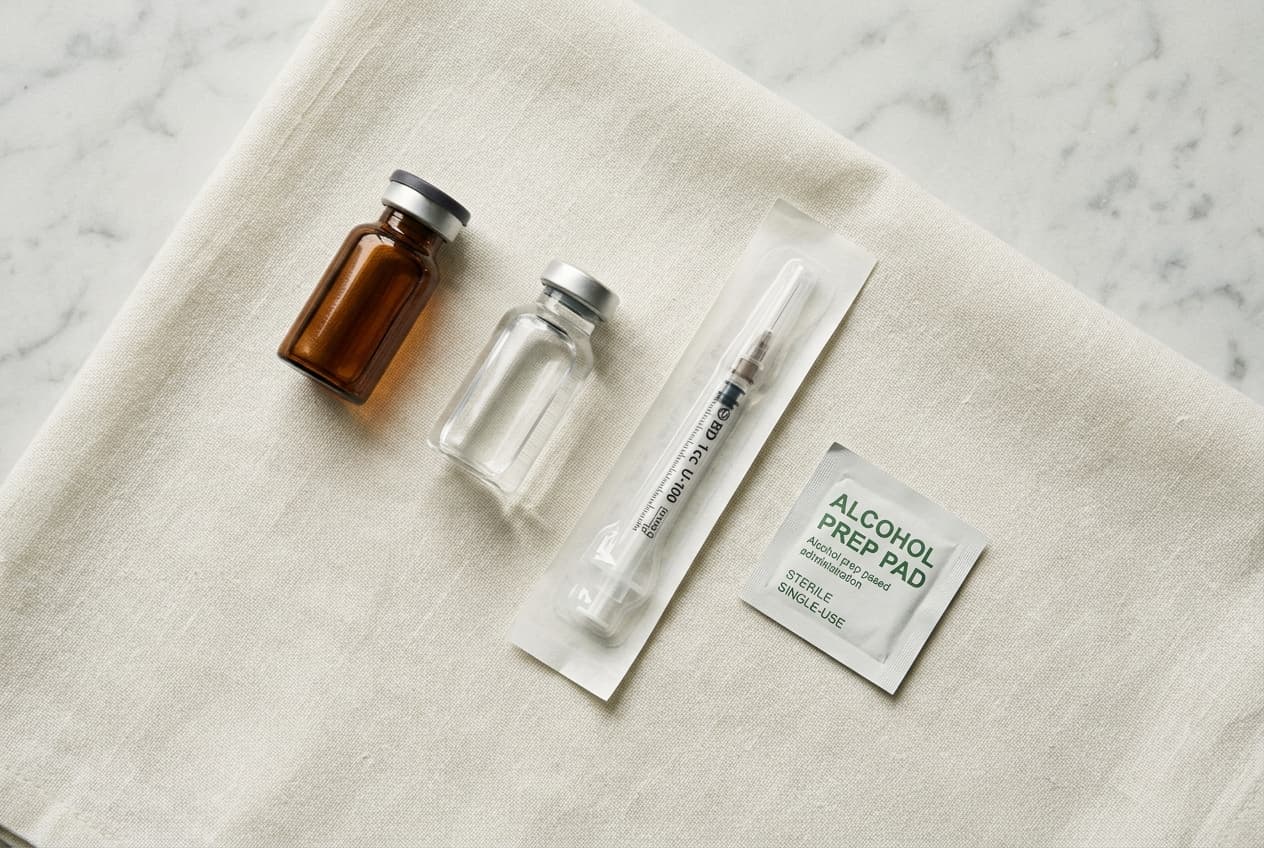
Egrifta comes as 1 mg or 2 mg vials of lyophilised powder. Reconstitute the 2 mg vial with 2.1 ml of supplied sterile water (or 2 ml of bacteriostatic water for research-grade material) to give roughly 1 mg/ml. A 2 mg daily dose draws about 2 ml — too much for a single insulin-syringe shot, so most users split into two 1 ml injections or use a 3 ml syringe. Subcutaneous into the abdomen, evening preferred. Reconstituted product is stable at fridge temperature for several days; the FDA label specifies use within hours, but the research-grade reconstitution with BAC water extends usable storage.
Open calculator pre-filledStorage after reconstitution
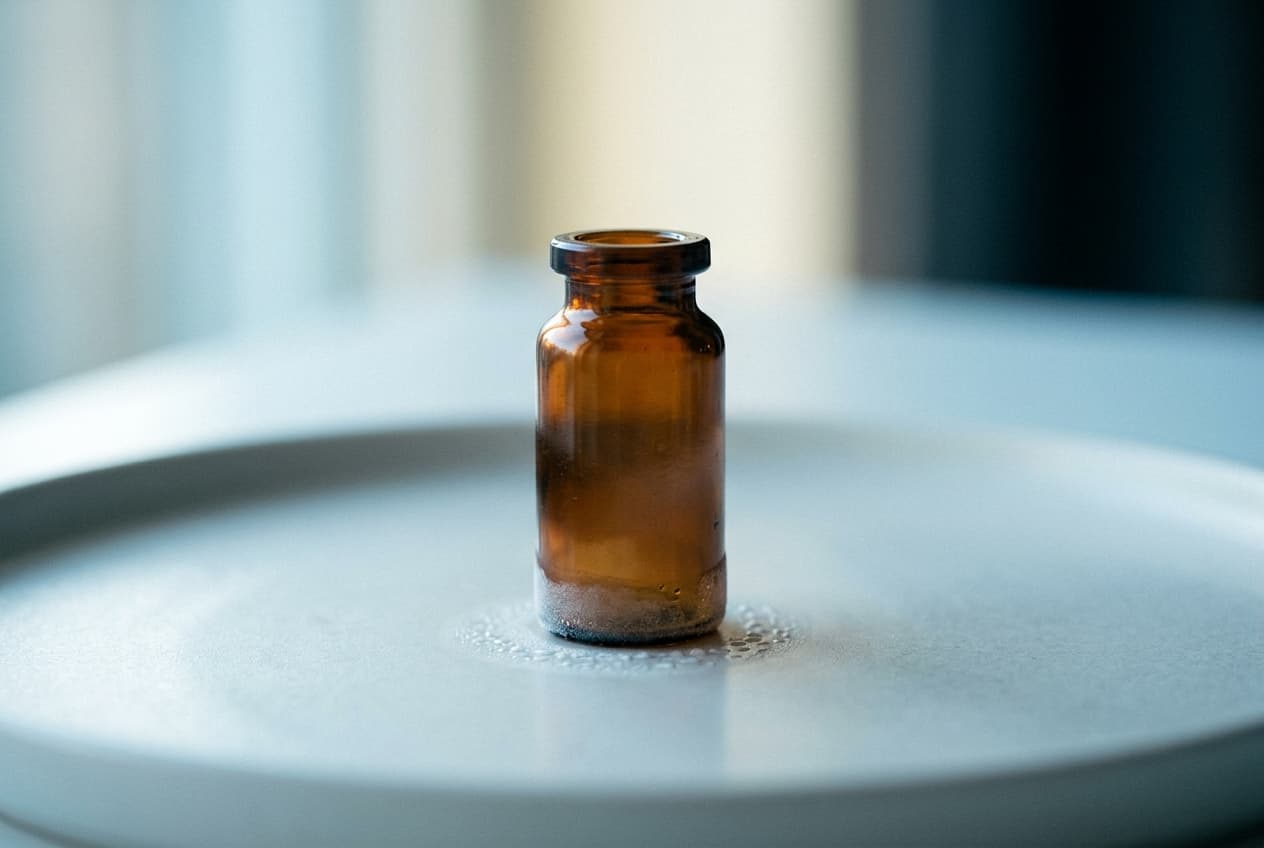
Refrigerate at 2–8 °C after reconstitution. Do not freeze. Light-protected. Stable for 14 days at fridge temperature per the manufacturer (Egrifta label). Research-grade tesamorelin in BAC water is comparable. The mannitol diluent (clinical product) gives slightly better stability than plain BAC water, but the difference is marginal in practice.
Common mistakes
Splitting the daily dose into two injections to 'mimic pulsatile' delivery.
Better approach: The pharmacokinetics of tesamorelin already produce a meaningful pulse from a single subcutaneous shot. Splitting blunts the peak and does not improve the AUC. The phase-3 protocol was once daily; do not deviate without a reason.
Expecting subcutaneous fat to disappear too.
Better approach: Tesamorelin's selectivity for visceral fat is the headline finding. It will not slim love handles, thighs, or arms. If the goal is overall fat loss, pair with a calorie deficit or use a different tool. The waist-to-hip ratio is the metric to watch, not body weight.
Skipping the glucose check.
Better approach: A 2 mg daily dose raises fasting glucose by a real amount in some users. Check fasting glucose and HbA1c at baseline, 8 weeks, and 16 weeks. If HbA1c climbs more than 0.3, drop to 1 mg/day or cycle off. The visceral-fat benefit is not worth a developing prediabetes.
Running tesamorelin indefinitely.
Better approach: The FDA-labelled cycle is 26 weeks of daily dosing, with continuation only if the benefit is maintained. Most off-label users transition to a 1 mg/day maintenance dose or cycle off entirely after 26 weeks. Indefinite dosing without re-evaluation is how the joint/fluid side effects creep up.
Real-world tips
- Measure waist circumference weekly with a soft tape, same time of day, same tape — the metric is sensitive to hydration so consistency matters.
- Track fasting glucose with a home glucometer once a week if you do not have lab access. The trend is what you care about, not any single value.
- Inject in the evening — the GH pulse pairs with your natural sleep-onset pulse for the strongest IGF-1 elevation.
- Rotate injection sites across the abdomen. The site reactions are small but cumulative if you hit the same spot twice in a week.
- If joint discomfort builds, drop to 1 mg/day for 2 weeks before resuming 2 mg/day. Most users tolerate the lower dose without complaint.
- The benefit takes time. If you are looking for week-2 waistline changes, you have the wrong expectation — measurable shifts appear at week 4–8.
When something else is the better tool
CJC-1295 + Ipamorelin
Use instead when: You want general GH-axis amplification for sleep, recovery, and gentle body recomp without paying for tesamorelin and without committing to a 26-week visceral-fat-focused course. CJC+Ipa is the broader, gentler, cheaper option.
Diet + cardiovascular exercise
Use instead when: Always run first. Visceral fat is the most responsive fat depot to a sustained calorie deficit and to cardio. Tesamorelin is for the visceral fat that has not yielded to the obvious interventions, not as a substitute for them.
Semaglutide / Tirzepatide
Use instead when: The goal is total weight loss including a meaningful visceral component. The incretins drive both subcutaneous and visceral fat loss as part of overall weight reduction, whereas tesamorelin is visceral-only and weight-neutral.
- Does it work for non-HIV users?
- Mechanistically yes, and the off-label community track record supports a similar visceral-fat effect. There is no dedicated phase-3 trial in non-HIV populations, so the evidence is borrowed. Most experienced users see a measurable waistline change by week 12 if they are also not gaining subcutaneous fat from a calorie surplus.
- How long does the benefit last after I stop?
- Phase-3 extension data shows that stopping tesamorelin allows visceral fat to gradually return over months. This is not a one-and-done protocol — sustaining the benefit requires either continued low-dose maintenance or sustained lifestyle factors (calorie balance, cardio, sleep) that keep visceral fat suppressed on their own.
- Will my IGF-1 climb a lot?
- Yes — tesamorelin raises IGF-1 by 50–100% in the trials. Check IGF-1 at baseline and at 12 weeks. The target range is the upper half of age-adjusted normal; supraphysiological IGF-1 is the warning sign that you are running too much for too long.
- Is the glucose effect permanent?
- No. Fasting glucose and HbA1c return to baseline within a few weeks of stopping the peptide. The concern is during dosing, not after, but if you have prediabetic baseline numbers the peptide will worsen them while you are on it.
- Can I combine it with HGH?
- Not without endocrinologist supervision. Stacking exogenous GH onto a stimulated endogenous GH pulse is how you push IGF-1 into supraphysiological territory, where the side-effect profile changes from manageable to serious.